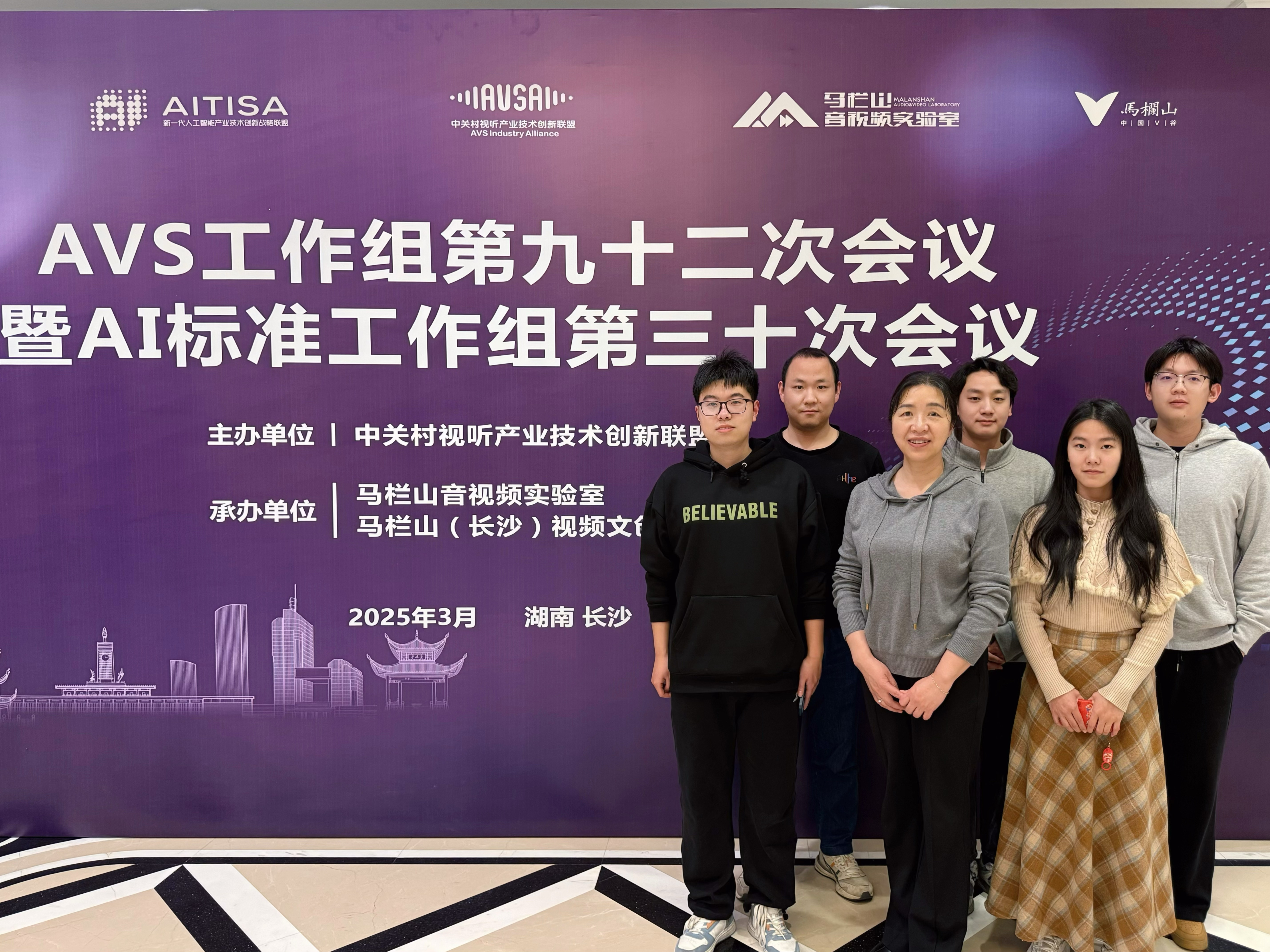
From March 12 to 15, 2025, the 92nd meeting of the AVS Working Group was held in Changsha. The lab’s coding group submitted three proposals: “Decoder-Side Non-Translational Affine Parameter Optimization for Affine Coding Blocks” by Zhong Yucheng, “ETMVP Candidate Motion Vector Optimization Based on Template Matching” by Li Hongbo, and “Improvement of Candidate Motion Vector List for Angular Weighted Prediction Mode” by Zhu Jiabao. All were reviewed and adopted by the AVS Video Group into the latest AVS4 reference software EVM platform.
The Audio Video Coding Standard (AVS) Working Group was established in June 2002 with the approval of the former Science and Technology Department of the Ministry of Information Industry. Its mission is to meet the needs of China’s information industry, unite domestic enterprises and research institutions, and formulate (revise) common technical standards for compression, decompression, processing, and representation of digital audio and video, providing efficient and economical codec technology for digital audio and video devices and systems, serving major information industry applications such as high-resolution digital broadcasting, high-density laser digital storage media, wireless broadband multimedia communications, and Internet broadband streaming media.
The first-generation AVS video coding standard was finalized in December 2003, with compression efficiency comparable to the contemporary international standard MPEG-2. Subsequently, an enhanced version AVS+ was proposed based on AVS and finalized in May 2012, with compression efficiency comparable to the contemporary international standard AVC/H.264. The second-generation AVS video coding standard (AVS2) was finalized in 2014, with compression efficiency comparable to the international standard H.265/HEVC. The third-generation AVS video coding standard (AVS3) began development in 2017, mainly targeting 8K ultra-high definition, and completed standardization in June 2021, with compression efficiency benchmarked against H.266/VVC.
Based on the development of technologies and applications such as UHD/HDR video, 3D video, panoramic video, VR/AR, and production domains, the fourth-generation AVS video coding standard (AVS4) officially released its requirements document in June 2023 to meet the needs of the future video industry. Currently, our lab’s coding group is participating in the development of AVS4 codec standard technologies.
Related link: The 92nd AVS Working Group Meeting Held Successfully